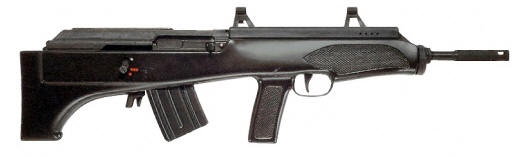
WESTINGHOUSE M25A1 PLASMA
RIFLE
SHOWN WITHOUT
FLEXY SIGHT OR CARRYING SLING ATTACHED
WESTINGHOUSE MODEL M-25 PLASMA RIFLE
EARLY 1st GEN HIGH ENERGY PLASMA WEAPON - STANDARD AMERICAN ISSUE
"He threw a
glance up into the blasted spires of the collapsed building and saw a dark shape
moving against the night sky; the H-K's turret.
Its searchlights swept down through the ruins. Reese checked the
"Pulse Remaining" level on his Westinghouse
M-25. The rifle had only one plasma pulse left. Take a shot.
Blind the son of a bitch. Resse aimed up at its
eyes, the infrared lenses of the gun mount.
Reese flipped up the
rifle's flexy sight -Oh, shit, faster, faster- stared
into the CRT scope- Move, Goddamnit, move- and
squeezed off a burst of high-energy plasma.
The H-K's ultra-high sensitive lens exploded into a shower of
glass and melted microchips.
Then the gleaming
black monster fired.
-Frakes and Wisher,
THE
TERMINATOR
|
|
|
|
MANUFACTURER: |
Westinghouse High Energy Arms Division
Also available in template form at any Series
III or higher construction facility |
|
PRODUCTION: |
02:10:1990
to 08:11:1997 A.D. by Westinghouse HEAD (WHEAD)
|
|
TYPE: |
Personal, fully portable very high energy weapon system - standard American combat rifle |
|
CONSTRUCTION: |
Enduralloy components mated to carbon fiber and moly
fiber carrier, misc. plastics and metals with superconducting filaments. |
|
OPERATION: |
Level III
magnetic field containment of refined hydrogen fuel excited with thermal
rapid pulse chemical high energy laser ignition system. High percentage
of component mass of plasma pulse cartridge forms core of pulse and
transitory lining of magnetic bottle during pulse initialization. |
|
BORE
SIZE: |
7mm / 4mm
magnetically stabilized and insulated smoothbore |
|
WEIGHT: |
3.35kg,
unloaded. Loaded box magazine of 40 plasma pulse cartridges weighs 1.5kg |
|
DIMENSIONS: |
Length
overall, 1.05 meters (1050mm) |
|
AMMUNITION: |
M109T5 PPC
plasma pulse cartridge, 7mm x 50mm, loaded into staggered box magazine Type 3AM8 very high density
crystal matrix battery, provides power for 120 shots (3 magazines) |
|
FEED
SOURCE: |
40 round
box magazine, standard. Optional 60 round staggered box magazine and
120 round drum magazine. |
|
RATE OF
FIRE:
|
60 pulses per minute (ppm)
initial, 30 ppm sustained given cooling cycle. Onboard diagnostic and
safety interface systems prevent weapon overheating by locking out firing
system if core temp rises beyond acceptable levels. Semi-automatic
cycling only. |
|
PROJECTILE: |
0.32 Mj phased plasma bolt, flow wash temp at +4500 degrees |
|
MUZZLE
VELOCITY:
|
Staged
hand-off coils accelerate bolt to a velocity of 9000 meters per second
(9.0kps). |
|
|
2000 meters
(bolt integrity destabilizes and cohesion factor approaches .85%
dispersal). Bolt reaches maximum range in 0.22 seconds. |
|
|
750 meters
(at this point bolt begins to lose cohesion, dispersal factor starts to
rise). Bolt reaches effective range in 0.083 seconds. |
|
PERFORMANCE: |
Contact hit
produces 5mm diameter entry point forming destructive tunneling of target
material through kinetic energy and super thermal contact. Upon
negative penetration or contact with a superior surface, bolt will
destabilize into high speed thermal tributary fragments with a one meter
lethal splash radius. Laser excited, magnetically accelerated 5mm x
400mm pre-emptive phased conversion thermal bolt will penetrate 4cm of case
hardened steel up to effective range with loss of overall penetration
commensurate with range after that. Immediate transfer of
thermo-kinetic energy to soft target tissues and standing fluids rated at
greater than 95% with high speed liquid to vapor thermal expansion.
High duration of residual thermal effects noted in hard surfaces struck by
plasma fire. Explosive displacement of up to one cubic meter of
material may result from bolt impact with material having trapped water or
water vapor inside (porous rock, concrete, masonry, etc.) with lethal spall out to one point five meters from point of
explosive decoupling of material cohesive structure. |
|
DAMAGE
INDEX:
|
Consistent
Damage Index of 95 / 3.5 representing at effective range the 5mm x 400mm bolt
will penetrate 95cm of standard ballistic gelatin with a wound channel
radiating out 3.5 cm from the point of impact narrowing from that radius in
accordance with depth and tensile strength of target material as the bolt
loses temperature and velocity. This index rating does not take into
account any standing liquids such as water or blood that may be encountered
as such liquids will be instantaneously vaporized thus greatly increasing the
wound channel radius through flash heating causing high velocity steam
expansion and lethal bursting of soft tissues over a large volume of body
area. |
HISTORY:
When SKYNET leveled the world, personal energy weapons were available in large percentages to the American military forces and to a much lesser extent to the Russians and the Chinese. It wasn't a matter of "if" high energy weapons would replace traditional projectile weapons on the battlefield so much as it was a matter of "when" and America seemed to have the lead not only in research but thanks to the sharing of reverse engineered technology through DARPA, industry giants Westinghouse and General Dynamics were already ramping up production of their combat and support high energy weapons to replace the traditional Colt M16 and the Browning M2HB HMG. America was the only standing First World army that had any large armounts of these weapons in their arsenals and newer designs were on the drawing boards. By 1997, Russia wasn't far behind in producing their first prototypes and China was trying its best to steal either of the other two countries designs since its own designs were still lagging farther behind than the Chinese would care to be.
Most scientists agreed in 1986 that the first working field issue prototypes of high energy weapons would probably appear within the next decade, give or take a handful of years either way. These scientists couldn't have known the snowball effect of the technological windfall that had fallen into America's lap courtesy of the T800's debris. It was a perfect time, as far as the American military industrial complex was concerned, for such a windfall of high, near miraculous technology to become available. During a time when America was decidely pulling ahead of both Russia and China in the Cold War arms race, the windfall of technology, no, the avalanche of ever developing technology derived from the debris of the T800 and Cyberdyne Systems' lead as well as cooperation through DARPA with the American military industrial complex, pushed America decades ahead of its two rivals.
The unexpected destruction of most of the
human race in 1997, of course, stalled any further development of these new types of
high energy weapons and, except for the American designs, destroyed the research and
development facilities where these advanced weapons were being tested in both Russia and China.
The
SKYNET was very careful in
its initial exchange to destroy what it could of anything that could be used
against it, namely strategic assets (long range missiles, ICBMs, big nukes and
any orbital weapon systems) as well as the theoretical and practical technology
centers of the Russians and the Chinese. The fact that most of these
centers were located near large civilian and industrial complexes made
collateral damage to those secondary targets an added consideration. The
return exchange from Russia and the very limited exchange from China wrecked
wide spread devastation over American high density population centers but for the most part
spared not only those areas that had been key in the construction of SKYNET but
also those areas which could quickly be brought back online after the
exchange. SKYNET protected its assets with ballistic interceptors and its
own emplaced, high energy weapons both ground mounted at
SKYNET, as part of its core
operations, had been programmed with all the theory, research, application and
science of American designed personal high energy weapons and it continued to
develop this chain of technology as rapidly as it could, realizing the
potential advantage. As SKYNET learned and developed at an incredible
rate, so did it's ability to research and develop
practical as well as theoretical technologies. Three years of research
into magnetic fields allowed SKYNET to produce smaller and smaller magnetic
bottles for the containment of plasma reactions. This led directly to the
advent and introduction of the subsequent generations of compact, high energy weapons.
The first truly portable
infantry-class personal high energy weapon, the M-25 plasma rifle, was
developed at the
The operation of the M-25
plasma weapon was simple. A magazine held a power cell and a small amount of
refined hydrogen fuel. When the trigger (firing actuator) was pulled, both
hydrogen and energy were siphoned off from the magazine and fed into their
respective parts of the weapon. The hydrogen was injected into a magnetic
bottle where it was compressed by powerful magnetic fields. The siphoned energy
from the magazine powered a rapid flex high energy pulse laser to nearly
instantaneously superheat the compressed hydrogen to a highly volatile, excited
plasma state, producing an ionized gas with a temperature of several thousand
degrees. The magnetic bottle was then opened on the 'barrel' end and a series
of staged magnetic fields both guided and accelerated the superheated plasma
bolt down the barrel. A high intensity infra-red pilot laser in the
weapon vaporized a line of sight path through the atmosphere to the target a
microsecond before the actual bolt was produced, resulting in less atmospheric
diffraction of the bolt and tighter cohesion of the plasma packet. The
plasma bolt followed the pilot laser beam at a muzzle velocity in excess of
8500 meters per second, packing a considerable amount of kinetic energy as well
as thermal energy upon impact. With the trigger held down, this routine
happened several times a second, allowing rates of
fire equal to the best large caliber automatic rifles. Excess temperature
was a problem, and full automatic fire often resulted in overheating and
premature weapon shutdown, with some extreme cases resulting in weapon damage
or even catastrophic detonation of the fuel cell on weapons with low serial
numbers and early batch production codes. Cyclic fire selectors were
built into the design, allowing for single shots or short bursts and offered
the weapon time to cool to safe operating temperatures in part to . Heavier weapons were built with integral cooling
systems and thus were capable of higher rates of sustained fire.
Personal body armor was easily
penetrated by the super hot plasma bolt which could burn its way through more
than a half meter of case hardened steel (one quarter meter of composite
laminate) in an instant. Organic targets struck by the bolt suffered severe
kinetic damage from the hyper velocity impact of the semi-solid bolt as well as
massive collateral and thermal damage from rapid fluid expansion, bolt
dispersion and subsequent plasma splash over. The high temperature plasma effected super heating of standing body fluids, resulting in
massive steam explosions which could explode apart a living person or neatly
amputate and cauterize a limb. Near misses produced horrible third degree
burns. A close hit against a more substantial material (such as armor plate
or a concrete wall) produced a 'splatter' effect where some of the plasma
became deadly, high speed super hot fragments. Modern personal body armor
(Kevlar) proved to be useless as protection against plasma weapons with
heavy vehicular composite armor such as Chobham and
other late development laminates providing largely diminished and only somewhat
effective protection.
Weighing in at only a
kilo more than the standard issue American M16A2 5.56mm assault rifle, the M-25
was housed in a polymer one piece stock, in a compact bullpup
configuration. The magazine (battery and fuel cell) for the M-25 was
only
slightly twice the weight of a standard 30 round M16 magazine. In
2001
A.D., the M-25 was supplemented by the M-25A1, a product improved model
with
slightly longer range and superior cooling capacity. By 2006
A.D., the M-25A1 PI Product Improved "phased" plasma rifle began
showing up in the hands of armed human
resistance and was much more effective against general combat Machines.
The A1 model also included a better designed anti-thermal bloom
deflector just ahead of the forward hand grip which greatly reduced
collateral plasma bloom flashback during sustained fire. Several
shipments of M-25A1 plasma rifles, produced at the A888 manufactory
macro-plant in Tulsa, OK, were hijacked by coordinated human Resistance
elements early in
2007 A.D. These weapons were then used against SKYNET's
forces in a variety of operational theaters and priority fronts in the
Midwestern
Throughout the War, from
2006 A. D. until the destruction of SKYNET in 2029 A.D., the M-25 plasma rifle, M25A1 phased plasma rifle (and later
the M25A2j phased plasma rifle) variants formed the mainstay of human weapons put into use against the
Machines. Human modifications to the M-25A1 and A2 series included
reworking the upper stock for the addition of various mechanical and digital
vision enhancement devices (most notably the TI M12 described below) as well as
using a clip to hold an extra magazine to the side of the magazine already
inserted (thus allowing for quick change during combat by dropping the spent
magazine, flipping it in your hand then slamming the fresh magazine back into
the weapon) and the inclusion of fore and aft swivels for combat slings. Some
resistance fighters mounted flashlights or infra-red spots under the fore grip
of their weapons, especially veterans with some years of experience in the
field.
_______________________________________________
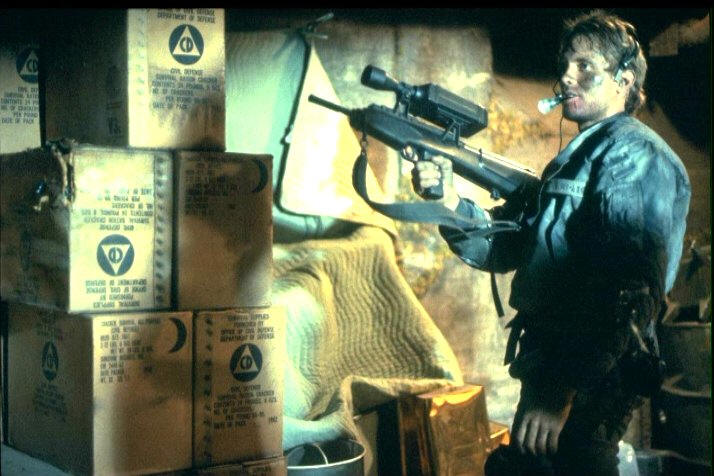
Kyle Reese shown with M25A1 phased plasma rifle with Flexy Sight, and combat sling. He is engaging a T800 infiltrator in an underground safe house and has just ejected his spent magazine. He is seen reaching for a fresh magazine of single-use power cells from his combat webgear, moving also to take cover as he reloads but never taking his eyes off of his target.